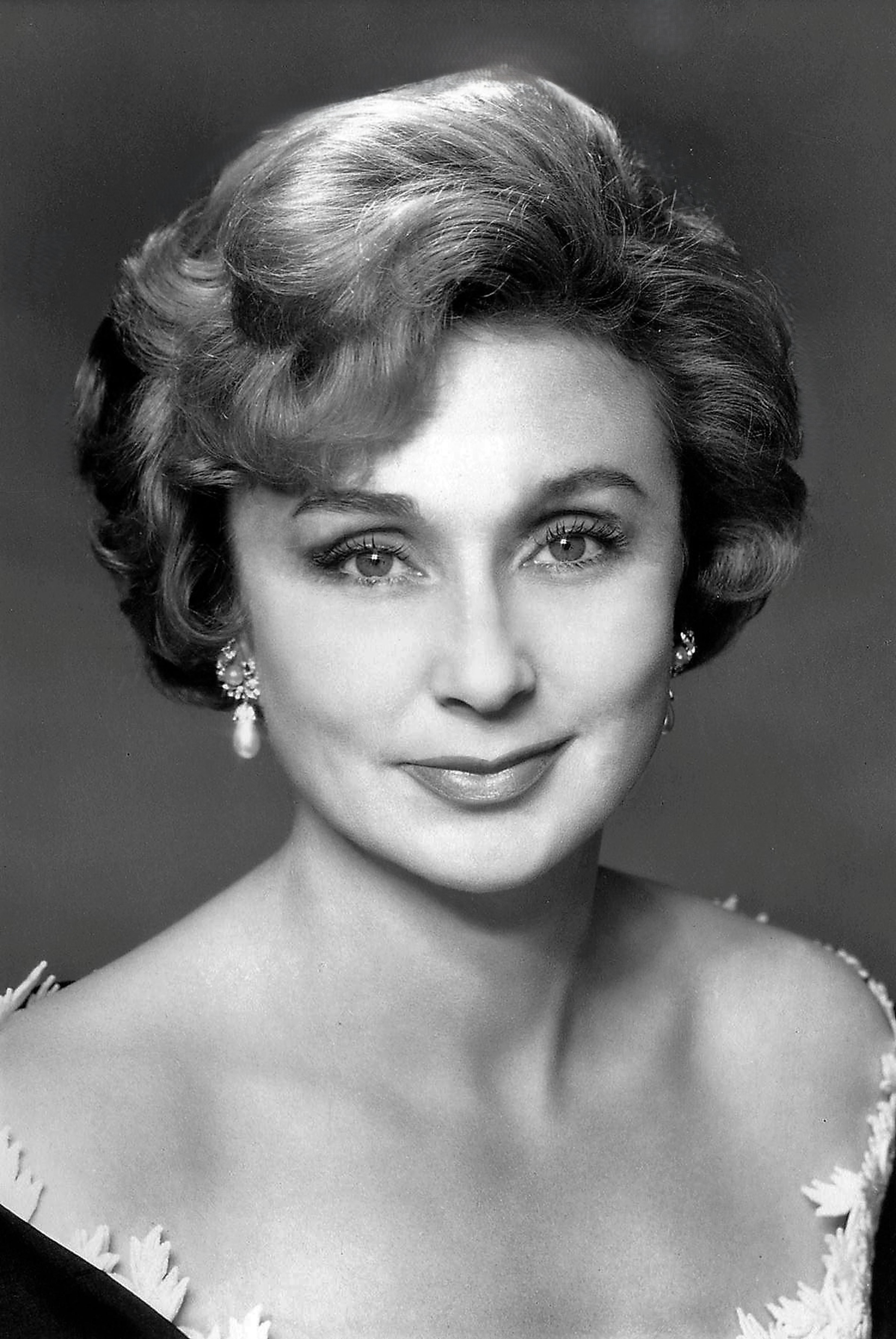
Googie and john were married for 62-years. They were married in 1948 at St. George’s Church, Hanover Square, London. It is the same church where Alfred P. Doolittle ties the knot in My Fair Lady, and which John directed in Australia.
Shockingly, Googie and John lived together for a time before they wed. They had to keep their living-in-sin a tight secret from the press because it would have ruined their careers. From John O’Groats to Land’s End, Googie would have been denounced from the pulpit. John would have been transported back to Botany Bay—in chains.
By any standard of creative reckoning, GOOGIE WITHERS was the most fascinating actor whom I came to know, with whom I worked, and spent time. Also, she was one of the most talented. I never tired of standing in the wings watching her captivate her audience. Never once did she phone-in the performance. Her closing night was as fresh as the opening night performance.
When JOHN MCCALLUM, wrote her biography—LIFE WITH GOOGIE—we were together in Chichester. It was a glorious summer, and they were starring in The Circle. John wrote the book in longhand, sitting in the shade of the large Oak at the bottom of the Bottle Cottage garden in Almodington. He wanted to call it GOOGIE—The Sonsie Girl. “It’s an old Scottish word. It means sassy,” he said, “and Googie is certainly that!” He said of her, “she has more moral courage than any person I know, and she will stand-up for her rights, regardless of the consequences.”
Googie and Michael Redgrave starred in a production of The Complaisant Lover on Broadway 1961—the Ethel Barrymore Theatre—together with Richard Johnson, Gene Wilder, Sandy Dennis—during one performance the elastic snapped in her knickers and they ended-up down around her ankles—and Nicholas Hammond who later played Friedrich von Trapp in The Sound of Music. It was directed by Glen Byam Shaw.
The play was not as successful as it might have been and Googie was incensed when the Broadway producer Irene Mayer Selznick—looking to apportion blame—complained it was because Googie was looking fat on stage. They were staying at the same hotel. Googie knocked on the door of her room, went in and stood in the middle of the room. She dropped the fur coat she was wearing and standing stark naked said: “Have a look and tell me which bit you think is fat.”

Googie with John McCallum, and his father John McCallum Sr

Googie in her dressing room, 1952
I came to realise Googie was a bit like marriage—not to be tangled with wantonly or lightly. Those who challenged her were met with the full implacability of her personality. She was not lacking in confidence. She knew her place in the theatre and she expected everyone to behave accordingly. On the first day of rehearsal a young actor—imbued with enthusiasm and excitement—walked-up to her and with a friendly, well-intended, “hello, Googie,” introduced himself. She said, shaking his hand: “How do you do, and I’m Miss Withers—until I tell you otherwise.” She never did—tell him otherwise, that is. Years later he was still calling her Miss Withers.
Googie had a well-deserved reputation for being imperious—although she disagreed vehemently—even when told it by her daughter, Joanna. Certainly, she was not beyond pulling rank—as Ed Deveraux learned when they worked together on the Australian play, 1966, The Desire of the Moth—written by James Brazill, directed by Raymond Westwell, and designed by Anne Fraser. It was not a success and proved a great disappointment to both Googie and John. They were keen to champion Australian talent. Years later, John said to me, “they complained JCW never did Australian plays. When we did the critics panned it. The reviews were dreadful and audiences were not interested.”
There was a serious contretemps in rehearsal. Googie and Ed clashed. Googie reminded Ed—in the plainest of terms—it was foolish to lock horns with the leading lady who just happened to be the wife of the producer. To amplify her clout, she added and pointed, “who is sitting upstairs in his office.” Neither harboured a grudge—but they did not forget. Years later, John was to cast Ed as the father in the television series, Skippy.

Publicity still for Desire of the Moth

Glamour shot of Googie
Googie, John, and Frank Thring, had been friends for many years. John had cast Frank as the villain of the piece. His role was to capture Skippy, to kill him, and eat him! Naturally, Skippy always escaped—leaving Frank wallowing in his wake as the pesky marsupial took-off in his helicopter, or soaked Frank with a spume of water as he escaped in a speedboat.
Frank arrived on the set for rehearsal and he noticed a sugarbag. When it began moving Frank enquired: “What’s in the bag.” Someone said, “Oh, that’s Skippy.” Without missing a beat he quipped. “If that’s the star’s dressing room, I can’t wait to see mine!”
Over the years I worked with Googie on some ten plays—including The Cherry Orchard directed by John Sumner, and An Ideal Husband directed by George Ogilvie at the Melbourne Theatre Company. Frank Thring and Googie were in both. He played her brother—Gaev—in The Cherry Orchard and was pitch perfect. One of the best things we did together. Paradoxically, Frank was very good at playing whimsical—given it was so unlike him.
I first became aware of Miss Withers when I was working with Harry M. Miller. He had the rights to the stage play, Butterflies Are Free, and Freddie Gibson offered her the role of the mother. Googie read it and declined. Having come to know her as I did, I am surprised Freddie made the offer. The lead character, Don Baker, is blind and it is his play. The role of the mother—which was, ultimately, played by Miriam Karlin—is supporting. Sean Scully played Don, and Wendy Hughes played Jill. Stewart Faichney played Ralph. Best looking juvenile cast you saw—ever!
At the same time I was working on The Secretary Bird with Patrick Macnee at the Palace Theatre in Sydney, Googie was appearing two blocks away at the Theatre Royal, Castlereagh Street, with Alfred Sandor in Plaza Suite, directed by John McCallum. It was Alfred Sandor’s first Australian show. He enjoyed it so much he stayed and married the theatre publicist, Barbara James.
We met at the Melbourne Theatre Company. Googie telephoned me on the Sunday evening before the first day of rehearsal for The Cherry Orchard. She asked a lot of questions and said she was looking forward to meeting with me. I lived in Palmerston Place, Carlton, in a one-bedroom—outside bathroom and loo—in a semidetached workman’s cottage. It was wonderful. When we came to know each other she invited herself—and Irene Inescort—to dinner—several times.

Googie as Mrs Cheveley in An Ideal Husband

Googie in The Cherry Orchard
Harry M. Miller had taught me how to deal with stars so I was not in awe. I do recall the first reading. I discovered over the years, Googie always arrived “well prepared”. She spent a couple of months working on the script in preparation and on the first day she more than half knew the part. I do not remember she ever called for a prompt in rehearsal. She was a star—and she knew exactly how she was going to play Lubov Andreyevna Ranevskaya. From then it only got better. En passant, I happened to mention the tapping of the breast three times as an Act of Contrition might be meaningful in a particular scene. The next rehearsal it was in.
John Sumner scripted her a wonderful version of The Cherry Orchard. Between them (actually it was John McCallum and not Googie) they wrote the Act II speech—“oh, my sins”—and she did not miss a beat. They gave her good words and she used them and her haughty sexuality to advantage. George Fromby said she had "a voice like Cointreau being poured over cracked ice." Dressed in cream silk chiffon designed by Kristian Fredrikson, and with a glorious hat made by Marjorie Head, and an ivory-handled, silk parasol, she was sensational.
Typically, Googie insisted the MTC provided her a wig from Wig Creations in London—where she was working prior to starting rehearsal on The Cherry Orchard. The Melbourne Theatre Company offices, rehearsal rooms, and workshops were on the corner of Normanby Road and Montague Street, South Melbourne. It was a dirty, sprawling space with a tin roof and no air-conditioning. The large rehearsal room on the first floor was appalling. We froze in the winter and cooked in the summer. The heating/cooling unit hanging from the ceiling in the centre of the room made so much noise it could not run while we rehearsed. Sometimes in the summer it was so hot we had to stop at regular intervals and run the system for relief from the heat.
Anyone who has worked with John Sumner will tell you—he did not use a deodorant. In the height of summer he hummed! Googie said to me: “Darling, Roland, John’s body odour is so bad, when he puts his arm around me I think I am going to faint. I have to hold my breath. You have to tell him.” I laughed. “He’s your friend,” I said. “You tell him.” She never did—tell him, that is—and she never fainted. She just went on holding her breath.
For whatever reason, Googie was having no truck with a local wigmaker working from the former D.W. Bingham & Co. manufacturing plant. Eventually, John Sumner acquiesced and Googie arrived clutching her wig. I seem to recall a cost of £250. She went to the wig department. Kathryn Denniss—with Kristian Fredrikson watching—fitted her in front of the mirror. The three of them stared. No one spoke a word. Finally, Googie said, “it’s awful!” Without a moment of hesitation, Kristian, in his inimitably understated manner, said, “yes, it is.” Googie was deeply embarrassed. “What do we do?” she said. “I can’t wear that.” Kristian said, “no, you certainly can’t.” It was Kathryn who saved the moment. “Don’t worry,” she said. “I’ll pull it apart and remake it.” Kathryn’s wig was a triumph. When the show went on tour Googie insisted Kathryn travel with the company.
Googie played Mrs. Cheveley in the MTC production of An Ideal Husband directed by George Ogilvie. The set and costumes were designed by Hugh Colman. The costume designs were glorious. Hugh—who has impeccable taste—made one of his rare mistakes with Googie’s Act I costume.
Googie was not overweight but she was a solid size 10-12. In Hugh’s design she wore an elaborate satin and lace creation in muted blues/greens/and pinks—rather like hydrangeas—and with small posies of flowers around the hips and the top of the train. It was the most beautiful gown; however, it did not well-serve Googie’s shapely form. The heavy train allowed Googie several opportunities to show her costume-wearing prowess and flick it with one foot—causing it to fall behind her in perfect array. On several occasions it earned her a round of applause.
John McCallum came to a dress rehearsal. In the first interval there was much discussion about the effect of the elaborate costume on Googie’s figure. I was asked to fetch Hugh to her dressing room. John Sumner, George Ogivly, Betty Druitt, John McCallum and I were all standing and staring at Googie, who was staring at herself in the mirror. John McCallum was being extremely charming with Hugh and making suggestions. Finally, Googie said, “Darling, Hugh, I look like the widow Twankey!” It was exactly the right thing to say about herself and everyone laughed.
An Ideal Husband was Hugh’s first “big” show, although we had done Galileo together at the Russell Street Theatre, directed by John Sumner. Hugh took the suggestions with good grace and removed the offending floral adornments from the skirt and made adjustments. It was not the most successful example of his brilliance. Hugh later agreed it was a mistake not to have followed the “scarlet woman” tradition for the Act I costume. It was, visually, the most beautiful production—thanks to Hugh’s designs.
The composite set—with steps and pillars—was blue/grey and white marble—actually it was superbly painted canvas. I cannot remember from where, but I secured a magnificent large, ballroom chandelier. I think it cost the company a couple of tickets to see the show—and a credit in the programme. Those were the days …

Googie and John in The Loves of Joanna Godden

Googie in a scene from On Approval, with costumes by Cecil Beaton
Googie said the hat Hugh designed for her in the Act II tea scene with Lady Chiltern—played by Diana Shearing—and Lady Markby—played by Irene Inescort—was the most beautiful she had worn—ever, “and that includes Cecil Beaton’s hats, and those from the film, The Loves of Joanna Godden.” The MTC’s Marjorie Head was a superb milliner. Kathryn Denniss made a glorious red wig for Googie as Mrs. Cheveley. It was the most flattering colour.
When it came to gloves in An Ideal Husband Googie was adamant. She would not wear elasticised evening gloves. They had to be 21 button opera length white kid leather. I was dispatched to George’s in Collins Street to purchase two pairs for $50. They were expensive. I was earning $120 a week—the same as Wendy Hughes—who never had any money! Some actors were only earning $80 a week.
Having lived with musical theatre star Evie Hayes in Alexandra Avenue, South Yarra, I knew she had the most superb collection of diamond paste jewellery which she had worn in Call Me Madam. The MTC had no such collection in their stockpile and it was needed for Mrs. Cheveley in An Ideal Husband. I called Evie and she kindly gave me a stage jewellery roll of bracelets, brooches, chokers, tiaras, and fabulous necklaces. They were worn by all the women in the cast—after Googie had claimed the lion’s share—including a fabulous necklace/collar of faux diamonds. It was so superb it looked real.
Talking of diamonds—Frank arrived at rehearsal wearing around his neck a dazzling bauble the size of a chicken’s egg.
“What’s that?” said Googie—pointing and waving her fingers as she did.
“It’s a diamond,” said Frank—his eyes twinkling.
“Darling,” said Googie. “If that were a diamond it would be in a Queen’s collection.”
“It is!” said Frank. Googie laughed for five minutes!
Evie’s generosity proved to be one of the few occasions I frowned at Googie’s behaviour. Evie was in the early stages of multiple sclerosis. She was still in public denial. “A skiing accident,” she told everyone. She had to be brought into the theatre in a wheelchair and helped into her seat. On opening night, and in return for the loan of the jewellery, Evie was seated centre, front row of the stalls. Sadly, managements—for whom she starred in musicals and kept the box-office ticking over—were already forgetting. She was so excited to have been invited. Evie was, at this time, a judge with Ron Tudor on Channel Ten’s, Young Talent Time.
Googie was a gifted raconteuse. She told theatrical stories with great relish—about everyone and herself—and she knew how to deliver the punchline. Whenever she was invited as a guest speaker she was always a great hit—audiences loved her. Like all theatrical stories—apocryphal or not—Googie never let the truth stand in the way of a good tale.
After the opening night of An Ideal Husband, Googie—thinking she was being amusing—was regaling her friends and making a joke of Evie in the front row of the Comedy Theatre. “There was Evie Hayes, sitting there—looking up at me and smiling—the whole time. I half expected her to give me a mark out of ten for my performance.” Everyone laughed. I thought it unworthy of Googie. I am not sure why, but it was not the only time I heard Googie being dismissive of Evie’s talent.
Frank played Lord Caversham. He was at his comedic best. When Frank dropped his shoulders in crest-fallen dismay he was brilliant. One performance he was standing beside me in the prompt corner. There was something different about his appearance. “Look at me,” I said. “What?” he replied in that tone-of-voice. It only took me a second. “You silly old goat,” I said. “You’ve glued your eyebrows on for your moustache, and your moustache for your eyebrows.” He shrieked and said. “I can’t tell the fucking difference.”
John Sumner taught me how to light a play. At the start of Googie’s Act II soliloquy he took down the ambient and brought-up the crosslighting specials of surprise pink and steel. Seated on a wooden bench, Googie became the focus of centre stage.
I watched her at every performance. Everyone on stage—including her—sat quite still. It was just her voice. She stared into the distance. At the end of the speech came a sound effect. She cut through the atmosphere like a hot knife through butter. She cocked her head—opened her mouth slightly—did that familiar look of surprise which I came to recognise—and said: “Do I hear music?” The timing of the cue was critical. The audience needed a pause to take a breath but Googie couldn’t be left holding the moment for too long. We never got it wrong. It was magical.
The Cherry Orchard and An Ideal Husband were used as part of Premier Dick Hamer’s Decentralisation Plan for Victoria. The cast of both plays—headed by Googie and Frank Thring, together with Wendy Hughes, Simon Chilvers, Dinah Shearing, and Dennis Olsen went on tour to Wangaratta—we played in the town hall with a flat floor—and to Albury/Wodonga at the War Memorial Civic Theatre. It was a triumph; however, the greatest triumph came at the Wednesday matinee of The Cherry Orchard for a house full of secondary school children at the Civic Theatre in Albury.
Who knows what happened—but it was magical. For the entire show you could have heard a pin drop. At the curtain call the children were standing and cheering. John Sumner was in the house. He came back and said: “Rock, what happened? What did you do that was different. It was perfect.” It never happened again—indeed it has never happened to me on another play. The planets in Albury on that day were in alignment. If only we had filmed it! In her own incomparable fashion, Googie recounted the performance: “The children were wonderful—they didn’t have streamers so they threw their rubbers and pencils onto the stage!” It did not happen—but it should have.

Googie and John’s wedding

Googie with John and Joanna on the occasion of John receiving his CBE
I loved being with John and Googie. We became friends. Both were wonderful company. They told the most marvellous stories—about everyone. John had an encyclopaedic knowledge of Australian theatre. He was a leading man to Gladys Moncrieff in The Maid of The Mountains. His father John McCallum Snr. owned the Cremorne Gardens/Theatre, South Brisbane, on the South Bank near the Victoria Bridge on part of the site where the Queensland Art Gallery now stands. It was a prominent, open-air vaudeville venue with seating for up to 3,000 patrons. It was destroyed by fire in 1954.
On a visit to Brisbane, John took Googie to see the family home where he had grown-up in Brisbane. There was a painting hanging on the wall. Googie stared in disbelief. “Was that picture always there?” she asked of John. He nodded it was. Googie said, “my blood ran cold. It was the view of the sea from my bedroom window at our house in Dorset. John and I had grown-up staring at the same view.”
John was a much better actor than was sometime realised—or acknowledged. He trained at RADA and unlike so many of his contemporaries he was never declamatory—nor was he a luvvie. He was a fine actor and naturalistic before it became fashionable. Like Googie, he, too, always made it seem as if he were making-up the dialogue as he went along. John was very funny—and it was effortless. He was prepared to do—and wear—whatever it took to make the performance work for the audience. He did not have a nerve in his body. He drove Googie mad.
When we were doing Stardust at the Comedy Theatre in Melbourne—and they were staying at the Rockman’s Regency Hotel across the road and the cricket was on the television—John would wander in at the 15-minute call (sometimes it was 5-minute call) —by which time Googie would be apoplectic. On one occasion to appease her I said he was in. Unusually, she went to check. “You told me he was in,” she said with a grin. John wore no make-up apart from a bit of eyebrow pencil. Sometimes he would say, “I can’t be bothered changing. They won’t know—I’ll just wear what I have on.” With that he wandered out onto the stage. He was always on the money.
Directly following John’s discharge from the Australian Imperial Force 1944—he fought in New Guinea during World War II—he joined the J.C. Williamson company. He was cast as the final leading man of Gladys Moncrieff in revivals of The Maid of The Mountains, and Rio Rita, 1944-45. Over her career, Moncrieff performed The Maid of the Mountains about 2,800 times and with 18 different leading men—John McCallum was officially the 18th and final one.
John fondly recalled Moncrieff as “splendidly vulgar, loud, and cheerful” during their time touring together.

John and Googie in The Circle
Googie played Lady Catherine Champion-Cheney and John played her estranged husband, Clive Champion-Cheney in Somerset Maugham’s, The Circle, at Chichester, directed by Peter Dews. Susan Hampshire—later Jenny Quayle took-over—played their daughter, Elizabeth. It was a huge success and transferred to the prestigious Theatre Royal at the Haymarket. It ran for 12-months playing to capacity houses which says something about Googie’s popularity. Her career had been given a new revival after starring in the television series Within These Walls—which became mandatory viewing for some 18-million British television watchers. Such was it popularity, policemen on point duty stopped the traffic to allow Googie to cross the road! Aged 57 she became a television star.
I remember when Googie sent the telegram accepting the role of Faye Boswell in Within These Walls. I gave her a huge box of Clarins products as a farewell and good luck gift. Not that she needed any good luck.
Googie shot 42 episodes over 3 series. Each episode was rehearsed like a play and then taped in sequence. She did it for two-years. She was at her zenith. Watching her work was a masterclass. Following her departure—“I was exhausted”—the critical and audience reception shifted noticeably. While the series remained a reliable rating success for London Weekend Television, reviewers and viewers felt the show lost some of its initial spark. Critics noted that neither Katharine Blake nor Sarah Lawson quite captured the unique, refined charisma Googie Withers brought to the screen. Her portrayal of the well-groomed, progressively minded Faye Boswell had anchored the series.
Googie went to HM Prison Holloway. She based her character—glamorous as it was—on the prisoner governors whom she met. “I found the governors to be extremely well-groomed.”
Reg Grundy offered her the same role in the Australian television series, Prisoner. It was a polite “thank you, but no thank you.” She had bigger fish to fry in the UK theatre—which was her fist love. The role went to Patsy King whose colouring was not dissimilar. Certainly, they copied her character’s style of dressing.
Bill Fraser played Lord Porteus in The Circle—the man for whom Lady Catherine Champion-Cheney left her husband Clive, and their daughter. Writing for The New Yorker during the West End run, critic Mollie Panter-Downes highlighted his specific physical comedy: “Bill Fraser gives a marvellously funny performance as the grumpy old paramour, Lord Porteous, whose new teeth keep slipping when he is in mid-bark.”
One of Googie’s more famous bon mots involved those false teeth. Googie—on her first galleon-in-full-sail entrance—and looking superb in a red wig—had some stage business which earned her an enormous laugh. Suddenly—and for no reason—the laugh started to come before she did the business. She was baffled. It happened for several performances. Suspecting something might be happening behind her—Googie glanced over her shoulder. Bill Fraser—following lugubriously in her wake—had—and much to the audience’s delight—started taking out his teeth with much comedy business. Googie was furious. They came-off after the scene and she turned to him and said: “Bill, darling, just remember you’re playing a Peer—not on the end of one!” He never did it again.
At the end of the Haymarket season The Circle went on a provincial tour. Joanna McCallum took over the role of the daughter, Elizabeth. Roger Davenport, later to become Joanna’s husband, also joined the cast.
Googie knew how to find a laugh—it was innate. Her timing was impeccable—and it was constant. Critics frequently noted how she tossed off Maugham’s sophisticated writing with absolute confidence, making the archaic dialogue feel natural, spontaneous, and bitingly funny. Specifically they focused on her supreme technical handling of the text, writing that as the eccentric, fading society dowager: “... Googie Withers throws away her epigrams with the ease and confidence of a master.”
Googie and John did The Circle in Australia in 1982-83. While they created the roles exactly as they had played them in the UK, the production was not an undiluted happy experience—nor did it enjoy the same degree of success. It was an excellent cast: Angela Punch McGregor, John Hamblin, Steven Tandy, Hugh Arnold, May Turner, Gordon Poole, and Gordon McDougall as Lord Porteus.

Googie with Hayley Mills and Ian Ogilvy in The Importance of Being Earnest, Chichester, 1979
To Googie and John, Somerset Maugham was Willy—Willy Maugham. William Douglas Home was another Willy. J.B. Priestley—who wrote They Came to a City for Googie—was Jack. She played in it for two years during the war. Ted Willis wrote the stage play Stardust for Googie and John.
I lived with them in London and Chichester. We ate together; travelled up-and-down the UK—and went to marvellous Sunday luncheons with friends. They knew everyone.
Twice I went with them to lunch with Susan, Lady Pulbrook at Partridge Green. She was the widow of Sir Eustace Pulbrook, the former chairman of Lloyd's of London. She died in 2011 aged 105. Lady Pulbrook and Rosamund Gould met by chance in 1956. Rosamund had trained as a florist under the great Constance Spry, who, also, co-created Coronation Chicken alongside chef Rosemary Hume—principal of the London Cordon Bleu Cookery School—for Queen Elizabeth II’s coronation banquet in 1953.
Lady Pulbrook and Rosamund Gould established Pulbrook and Gould florist shop. Around 1956, they moved to premises at 181 Sloane Street, Chelsea. It was “THE” most beautiful shop. The banks of sweet peas were too beautiful. The scent was overpowering.
The house in Partridge Green was quite small and rather sweet. She had a local daily woman who came in to cook. I only remember the pudding. It was apple and rhubarb pie with clotted cream. She insisted I have two helpings. I liked it so much she made sure it was served the second time I came calling for lunch.
Googie loved to eat and she took me to all the best restaurants and hotel dining rooms in London. The Savoy Grill was a favourite. She always got the best table. On being noticed coming into the dining room it was not unusual for other diners to rise from their seats and to applaud. I have seen ladies curtsy to her.

1740 Pittwater Road, Bayview

View from the back of the house at Bayview
They lived in Bayview in Sydney. Often when we were sitting on the back verandah—gazing out across Pittwater to Scotland Island—Googie would sit in a white cane chair with her crossed legs and resting halfway-up the wall. Having been a gymnast—she was a one-time British champion—she had great flexibility and she found it a comfortable position to sit and talk!
Googie had a three-legged milkmaid’s stool at the house in Bayview. When she was feeling a bit peckish, one of her favourite things was to sit in front of the fridge with the door wide open and eat what ever happened to catch her eye. According to Googie’s father—who told John when he came calling and asking for her hand in marriage—“Googie will make you a wonderful wife but there is something you should know.” John’s heart sank imagining the worst—“he’s going to tell me she can’t have children!”, he thought. It was nothing so dire. “Googie”, her father said to John with no hint of humour, “eats more food than anyone I know.” It was true. In restaurants she could not resist having a taste of whatever someone else was eating. If you left something on the plate—she finished it. “Darling, don’t waste that. Give it to me—I’ll eat it.”
Googie and John led busy social lives and were the most superb hosts. Googie kept a good table and they did throw the most wonderful parties. They had friends from every walk of life.
Gordon Chater arrived with Gwen Plumb to be greeted at the front door by Googie saying: “Come in, darlings—how wonderful to see you. The house is full of people who love us—but never pay to see us!”
Googie, John, and Frank Thring did The Kingfisher. On behalf of Malcolm Cooke I suggested the idea to them while we were at Chichester together and they accepted. Frank was the obvious choice for the manservant—they had been friends for so long and Googie and Frank worked together so agreeably at the Melbourne Theatre Company. I am not certain why but Googie and Frank were at odds. She did not enjoy working with him and Frank was equally indifferent; also, he was at a point in his career where he tended to imbibe more than was good for the sharpness of his performance. It was sad to see the talent withering and dying on the vine. John Frawley was Frank’s understudy and I am surprised he was never called to take-over.

John and Googie in The Kingfisher
The detail of Googie and Frank’s falling-out is not important but it did sour their relationship. There was one particularly unpleasant encounter and I am not sure their association ever recovered. At the end of his life, Frank was in dire health and was being difficult to his own detriment. At my behest, Googie phoned to try and encourage him to follow his doctor’s advice. Frank told her to “fuck-off” and hung-up on her. It was the last time, ever, they spoke. It was an unfortunate ending to a long friendship.
John Frost was the stage manager on The Kingfisher. It was his first time working with Googie and John. It proved the start of a most productive journey. John brought them to Australia in what was to be their last stage appearance in this country. “I have been many times to the well,” she said, “and it has been very good to me.” Googie was playing Lady Markby and John was playing the Earl of Caversham in Peter Hall’s production of An Ideal Husband. At the end of their careers Frost co-produced with McCallum, Lady Windermere’s Fan. Googie and John headlined a cast headed by Vanessa Redgrave and her daughter, Joely Richardson, and again directed by Peter Hall.
It played at the prestigious Theatre Royal at the Haymarket—the scene of one of Googie’s greatest London triumphs—The Circle.
It was a fitting end to a glittering career.
To be continued ...